A fully data driven gravity wave parameterization
Published:
Elias Haslauer, a PhD student with Mierk Schwabe and Veronika Eyring at DLR has just submitted a paper on a novel approach to parameterize gravity wave momentum transport with machine learning to Machine Learning: Earth. This work began when I was on sabbatical at DLR!
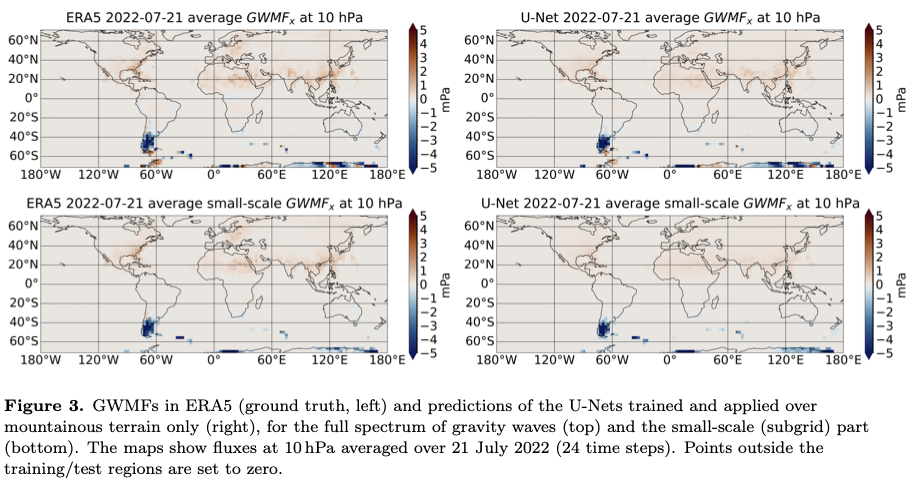
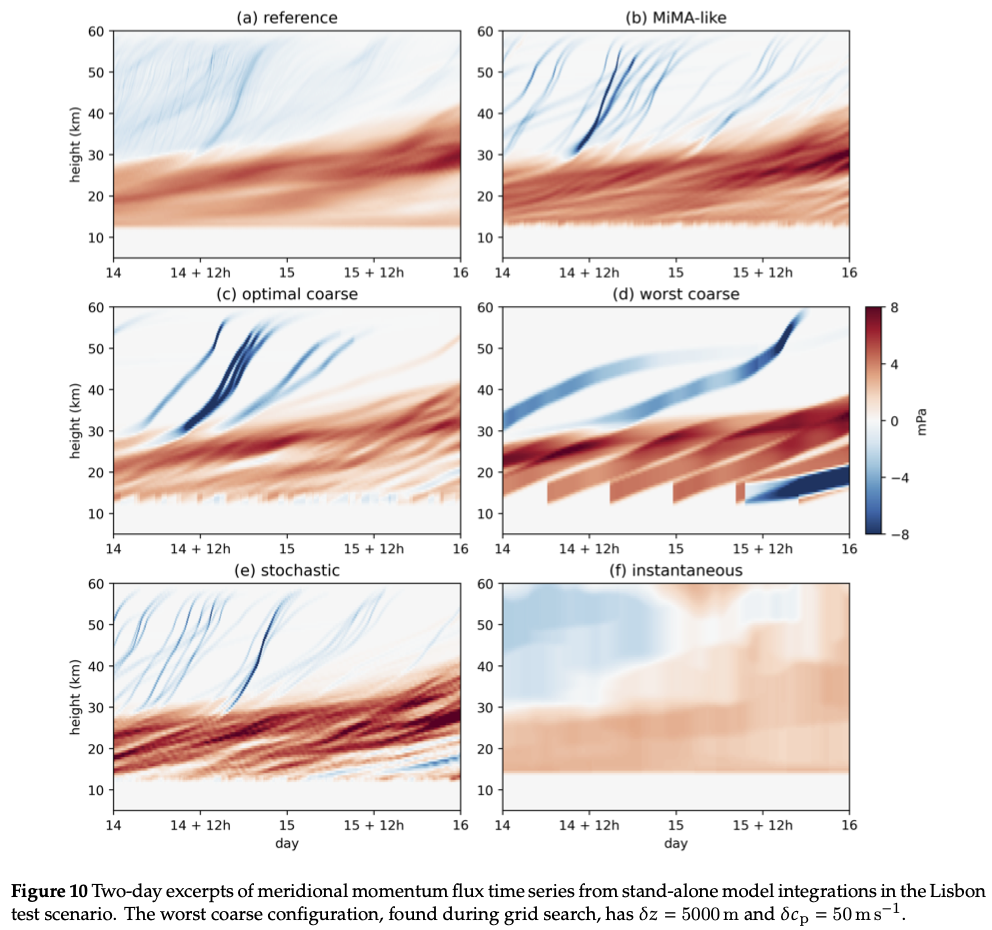
The goal of the study, entitled “Interpretable Neural Networks to Predict Momentum Fluxes of Orographic Gravity Waves”, was to develop a fully data-driven, single column parameterization that could accuarately capture un- and underesolved gravity wave momentum transport. Our target is a low resolution climate model, with a nominal grid spacing of 300 km allowing it to (at best) capture gravity waves on scales of 2000 km and above. We want to supply the momentum transport from waves of scale approximately 200-2000 km, as computed from ERA5 reanalysis. (This is not the full spectrum, but we don’t trust gravity waves below 200 km from a reanalysis with 25 km resolution.) Given the winds, temperature, and information about unresolved topography, the data-driven parameterization had to reconstruct the missing fluxes. It does a remarkably good job, especially when compared against base-line physics based parameteriations!
I’m particularly excited about the feature importance analysis Elias employed to interpret the neural network parameterizations. He found that the neural network zeroed in on wind conditions around the target level, suggesting that information about critical layers was essential. It was remarkably similar to what David Connelly found with a physics based parameterization and emulator. A critical layer occurs when a simple, planar gravity wave reaches a height where the phase velocity matches that of the local wind. According to theory, it should slow down and be damped out before it reaches the critical layer. (It would also tend to grow in amplitude, which would make it more nonlinear and susceptible to dissipation.) The GW momentum flux in ERA5 cared very much about the local wind, suggesting that real waves behave somewhat similar to their theoretical cousins!