<?xml version="1.0" encoding="utf-8"?><feed xmlns="http://www.w3.org/2005/Atom" ><generator uri="https://jekyllrb.com/" version="3.10.0">Jekyll</generator><link href="https://edwinpgerber.github.io/feed.xml" rel="self" type="application/atom+xml" /><link href="https://edwinpgerber.github.io/" rel="alternate" type="text/html" /><updated>2026-05-15T11:41:26-04:00</updated><id>https://edwinpgerber.github.io/feed.xml</id><title type="html">Edwin P. Gerber</title><subtitle>Professor</subtitle><author><name>Ed Gerber</name><email>epg2@nyu.edu</email></author><entry><title type="html">The recurrence of atmospheric blocking</title><link href="https://edwinpgerber.github.io/posts/2026/04/22/" rel="alternate" type="text/html" title="The recurrence of atmospheric blocking" /><published>2026-04-22T00:00:00-04:00</published><updated>2026-04-22T00:00:00-04:00</updated><id>https://edwinpgerber.github.io/posts/2026/04/blog-post-1</id><content type="html" xml:base="https://edwinpgerber.github.io/posts/2026/04/22/"><![CDATA[<p>Wow, a busy month.  Ka Ying Ho, a PhD student with <a href="https://www.leiw.org/about">Lei Wang</a> at Purdue University, just submitted an <a href="https://edwinpgerber.github.io/files/ho_etal-JC-submitted.pdf">investigation into the return period distribution of atmospheric blocking</a> to the Journal of Climate!  It is joint work with <a href="https://www.bc.edu/bc-web/schools/morrissey/departments/eesc/people/faculty-directory/yi-ming.html">Yi Ming</a> at Boston College. 
<br /> <img src="/images/2026-04d.png" /></p>

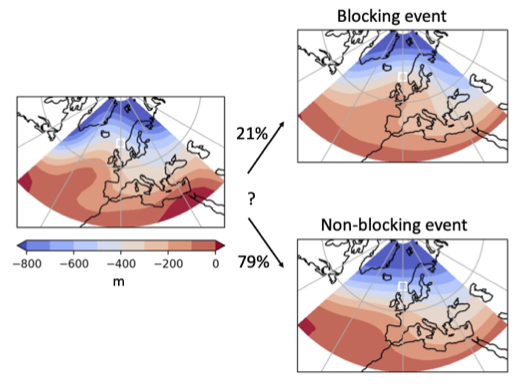
<p>Atmospheric blocking is a large-scale weather pattern in the midlatitudes associated with various types of extreme events, such as heat waves, droughts, and cold spells. Understanding its regularity in time can help us better predict its onset and understand the forecast limit of blocking. Using a hierarchy of simple red-noise models, we identify the key parameters that contribute to the recurrence pattern of blocking, specifically, the climatological onset frequency and the temporal correlation of Rossby waves, which shape the return period distribution and
timescale. These insights also help interpret changes in the pattern of recurrence and forecast challenges in a warmer climate from the CESM1 simulations, where a decrease in blocking events increases the uncertainty of their recurrence.</p>]]></content><author><name>Ed Gerber</name><email>epg2@nyu.edu</email></author><category term="submitted" /><summary type="html"><![CDATA[Wow, a busy month. Ka Ying Ho, a PhD student with Lei Wang at Purdue University, just submitted an investigation into the return period distribution of atmospheric blocking to the Journal of Climate! It is joint work with Yi Ming at Boston College.]]></summary></entry><entry><title type="html">A fully data driven gravity wave parameterization</title><link href="https://edwinpgerber.github.io/posts/2026/04/20/" rel="alternate" type="text/html" title="A fully data driven gravity wave parameterization" /><published>2026-04-20T00:00:00-04:00</published><updated>2026-04-20T00:00:00-04:00</updated><id>https://edwinpgerber.github.io/posts/2026/04/blog-post-1</id><content type="html" xml:base="https://edwinpgerber.github.io/posts/2026/04/20/"><![CDATA[<p>Elias Haslauer, a PhD student with Mierk Schwabe and Veronika Eyring at  <a href="https://www.dlr.de/en/dlr/locations-and-offices/oberpfaffenhofen">DLR</a> has just submitted a paper on <a href="https://edwinpgerber.github.io/files/haslauer_etal-MLE-submitted.pdf">a novel approach to parameterize gravity wave momentum transport with machine learning</a> to Machine Learning: Earth.  This work began when I was on sabbatical at DLR!
<br /> <img src="/images/2026-04c.png" /></p>

<p>The goal of the study, entitled “Interpretable Neural Networks to Predict Momentum Fluxes of Orographic Gravity Waves”, was to develop a fully data-driven, single column parameterization that could accuarately capture un- and underesolved gravity wave momentum transport.  Our target is a low resolution climate model, with a nominal grid spacing of 300 km allowing it to (at best) capture gravity waves on scales of 2000 km and above.  We want to supply the momentum transport from waves of scale approximately 200-2000 km, as computed from ERA5 reanalysis.  (This is not the full spectrum, but we don’t trust gravity waves below 200 km from a reanalysis with 25 km resolution.)  Given the winds, temperature, and information about unresolved topography, the data-driven parameterization had to reconstruct the missing fluxes.  It does a remarkably good job, especially when compared against base-line physics based parameteriations!</p>

<p>I’m particularly excited about the feature importance analysis Elias employed to interpret the neural network parameterizations.  He found that the neural network zeroed in on wind conditions around the target level, suggesting that information about critical layers was essential. It was remarkably similar to what <a href="https://doi.org/10.1029/2023MS004184">David Connelly found with a physics based parameterization and emulator</a>.  A critical layer occurs when a simple, planar gravity wave reaches a height where the phase velocity matches that of the local wind.  According to theory, it should slow down and be damped out before it reaches the critical layer.  (It would also tend to grow in amplitude, which would make it more nonlinear and susceptible to dissipation.)  The GW momentum flux in ERA5 cared very much about the local wind, suggesting that real waves behave somewhat similar to their theoretical cousins!</p>]]></content><author><name>Ed Gerber</name><email>epg2@nyu.edu</email></author><category term="submitted" /><summary type="html"><![CDATA[Elias Haslauer, a PhD student with Mierk Schwabe and Veronika Eyring at DLR has just submitted a paper on a novel approach to parameterize gravity wave momentum transport with machine learning to Machine Learning: Earth. This work began when I was on sabbatical at DLR!]]></summary></entry><entry><title type="html">Gravity wave momentum transport on a budget</title><link href="https://edwinpgerber.github.io/posts/2026/04/09/" rel="alternate" type="text/html" title="Gravity wave momentum transport on a budget" /><published>2026-04-09T00:00:00-04:00</published><updated>2026-04-09T00:00:00-04:00</updated><id>https://edwinpgerber.github.io/posts/2026/04/blog-post-1</id><content type="html" xml:base="https://edwinpgerber.github.io/posts/2026/04/09/"><![CDATA[<p><a href="https://dsconnelly.github.io/">David Connelly</a> just submitted a paper on <a href="https://edwinpgerber.github.io/files/connelly_etal-JAMES-submitted.pdf">Fast, accurate parameterization of atmospheric
gravity waves, accounting for transient dynamics</a> to the Journal of Advances in Modeling the Earth System.
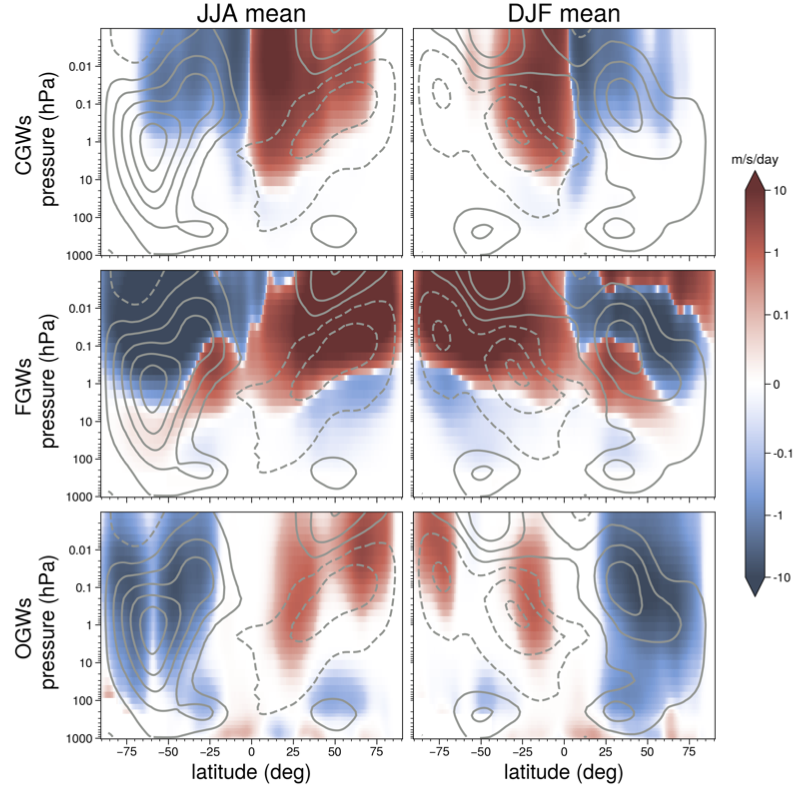
<br /> <img src="/images/2026-04b.png" /></p>

<p>Gravity waves are oscillations in the atmosphere driven by buoyancy and the pull of Earth’s gravity. Common sources include wind blowing over mountains and disturbances associated with convective storms. But while they are typically generated at the surface or in the lower atmosphere, gravity waves can propagate long vertical distances into the stratosphere and affect the velocity and direction of the winds there. Atmospheric models usually represent this propagation as occurring instantaneously, but in reality it takes hours or days, and this transience can significantly alter where and by how much gravity waves accelerate the wind. Transience has historically been too computationally expensive to include in numerical simulation of the atmosphere, but in this paper we find efficient configurations of a model of transient propagation. It proves important to balance the length and time scales of the modeled waves against the available computational power. Using a simplified model, we systematically identify the optimal configuration parameters under significant computational constraints. We then verify that this low-cost configuration performs well when included in a full atmospheric model.</p>]]></content><author><name>Ed Gerber</name><email>epg2@nyu.edu</email></author><category term="submitted" /><summary type="html"><![CDATA[David Connelly just submitted a paper on Fast, accurate parameterization of atmospheric gravity waves, accounting for transient dynamics to the Journal of Advances in Modeling the Earth System.]]></summary></entry><entry><title type="html">Why is the storm track stronger in the austral hemisphere than the boreal?</title><link href="https://edwinpgerber.github.io/posts/2026/04/02/" rel="alternate" type="text/html" title="Why is the storm track stronger in the austral hemisphere than the boreal?" /><published>2026-04-02T00:00:00-04:00</published><updated>2026-04-02T00:00:00-04:00</updated><id>https://edwinpgerber.github.io/posts/2026/04/blog-post-1</id><content type="html" xml:base="https://edwinpgerber.github.io/posts/2026/04/02/"><![CDATA[<p><a href="https://chaimgarfinkel.es.huji.ac.il/">Chaim Garfinkel</a> just submitted a paper on <a href="https://edwinpgerber.github.io/files/garfinkel_etal-WCD-submitted.pdf">Building blocks of localized storm tracks: revisiting asymmetries
between the NH and SH in storm track strength</a> to <a href="https://www.weather-climate-dynamics.net/">Weather and Climate Dynamics</a>.
<br /> <img src="/images/2026-04a.png" /></p>

<p>The storm track in the austral (or southern) hemisphere is stronger than that of the boreal (northern) hemisphere.  We show how differences in the reflectivity (or albedo) of our planet, continents, and ocean heat transport from the southern hemisphere to the northern hemisphere zonally localize the storm tracks and strengthen storms in the south relative to the north.</p>

<p>More technically, using a intermediate-complexity atmospheric model, we investigate the forcing of localized storm
tracks by land–sea contrast, horizontal gradients in ocean heat uptake, planetary albedo, and topography. The additivity of the
response to these “building blocks” is investigated. Building on previous work focusing on stationary waves, the storm track
patterns and strength are not simply the linear additive sum of the response to each surface inhomogeneity. As observed on
Earth, the SH storm tracks are stronger than those in the NH, and also stronger over ocean basins than over continents. In this
model, the most important building block for this asymmetry is land-sea contrast, however, there is substantial non-additivity
both in the regional structure and also the hemispheric asymmetry.</p>

<p>An energy budget perspective offers some insight on the
causes of the non-additivity, and highlights how the net impact of each building block on outgoing longwave radiation is
dependent on the existence of the other two. Relatively small changes in oceanic heat transport from the Southern Ocean to the
North Atlantic have a pronounced impact on the individual terms making up the energy budget, however there is substantial
cancellation between these terms leading to a small impact on the NH vs. SH asymmetry in storm track strength. The detailed
structure of albedo has a weak impact on the NH vs. SH asymmetry due to substantial cancellation between the changes in
individual terms making up the energy budget, even though the albedo profile has a large impact on the overall transient eddy
activity in each hemisphere.</p>]]></content><author><name>Ed Gerber</name><email>epg2@nyu.edu</email></author><category term="submitted" /><summary type="html"><![CDATA[Chaim Garfinkel just submitted a paper on Building blocks of localized storm tracks: revisiting asymmetries between the NH and SH in storm track strength to Weather and Climate Dynamics.]]></summary></entry><entry><title type="html">Moisture makes the atmosphere less efficient?</title><link href="https://edwinpgerber.github.io/posts/2025/11/03/" rel="alternate" type="text/html" title="Moisture makes the atmosphere less efficient?" /><published>2025-11-03T00:00:00-05:00</published><updated>2025-11-03T00:00:00-05:00</updated><id>https://edwinpgerber.github.io/posts/2025/11/blog-post-1</id><content type="html" xml:base="https://edwinpgerber.github.io/posts/2025/11/03/"><![CDATA[<p>Marguerite Brown just published our work on <a href="https://doi.org/10.1175/JAS-D-24-0179.1">On the Inefficiency of Moist Geostrophic Turbulence: A Theory for the Energetic Output under Subsaturated Conditions </a> in JAS! 
<br /> <img src="/images/2025-11.png" /></p>

<p>The impact of humidity on the strength of midlatitude storms is not well understood. Humidity will increase as the planet warms, but it is unclear whether storms will become stronger or weaker as a result. We use an idealized computer model to learn how humidity will impact the strength of storms. We focus on the effect of evaporation at the planet’s surface, with simulations ranging from a completely dry atmosphere to one with rain everywhere. In between these two limits, it is raining in only part of the atmosphere, and storms are much weaker than in the case with rain everywhere. Somewhat counterintuitively, moisture makes the atmosphere less efficient at creating storm activity, despite the fact that latent heating plays a key role in driving individual storms!  We discuss how to connect these results to more complex models and real-world data.</p>]]></content><author><name>Ed Gerber</name><email>epg2@nyu.edu</email></author><category term="in press" /><summary type="html"><![CDATA[Marguerite Brown just published our work on On the Inefficiency of Moist Geostrophic Turbulence: A Theory for the Energetic Output under Subsaturated Conditions in JAS!]]></summary></entry><entry><title type="html">Drying the Mediterranean</title><link href="https://edwinpgerber.github.io/posts/2025/08/29/" rel="alternate" type="text/html" title="Drying the Mediterranean" /><published>2025-08-29T00:00:00-04:00</published><updated>2025-08-29T00:00:00-04:00</updated><id>https://edwinpgerber.github.io/posts/2025/08/blog-post-1</id><content type="html" xml:base="https://edwinpgerber.github.io/posts/2025/08/29/"><![CDATA[<p><a href="https://www.physics.ox.ac.uk/our-people/keller">Benny Keller</a> just published our work on <a href="https://doi.org/10.1175/JCLI-D-24-0659.1">Disentangling Projected Stationary Wave Changes: Implications for Future Drying of the Mediterranean Region</a> in the Journal of Climate! 
<br /> <img src="/images/2025-08.png" /></p>

<p>Climate models project a reduction of precipitation over the Mediterranean under global warming. This trend appears to be associated with shifts in the large scale atmospheric circulation which steer rain away from the region.  In a collaborative study with Benny Keller and Chaim Garfinkel at Hebrew University Jerusalem, we try to sort out why is this happening.  The answer, it turns out, is complicated!</p>

<p>We use an intermediate-complexity general circulation model to disentangle changes in the large-scale zonally asymmetric circulation in response to rising greenhouse gases. Particular focus is on the anomalous ridge that develops over the Mediterranean in future climate projections, directly associated with reduced winter precipitation over the region.</p>

<p>Specifically, we examine changes in stationary waves forced by land–sea contrast, horizontal oceanic heat fluxes, and orography, following a quadrupling of CO2. The stationary waves associated with these three drivers depend strongly on the climatological state, precluding a linear decomposition of their responses to warming. However, our modeling framework still allows a process-oriented approach to quantify the key drivers and mechanisms of the response. A combination of three similarly important mechanisms is found responsible for the rain-suppressing ridge. The first is part of a global response to warming: elongation of intermediate-scale stationary waves in response to strengthened subtropical winds aloft, previously found to account for hydroclimatic changes in southwestern North America. The second is regional: a downstream response to the North Atlantic warming hole and enhanced warming of the Eurasian landmass relative to the Atlantic Ocean. A third contribution to the Mediterranean Ridge is a phase shift of planetary wave 3, primarily associated with an altered circulation response to orographic forcing. Reduced land–sea contrast in the Mediterranean basin, previously thought to contribute substantially to Mediterranean drying, has a negligible effect in our integrations. This work offers a mechanistic analysis of the large-scale processes governing projected Mediterranean drying, lending increased understanding and credibility to climate model projections.</p>

<p>Benny was a masters student with Chaim Garfinkel at Hebrew University Jerusalem.  He’s now moved on to greener pastures, pursuing his PhD at Oxford!</p>]]></content><author><name>Ed Gerber</name><email>epg2@nyu.edu</email></author><category term="in press" /><summary type="html"><![CDATA[Benny Keller just published our work on Disentangling Projected Stationary Wave Changes: Implications for Future Drying of the Mediterranean Region in the Journal of Climate!]]></summary></entry><entry><title type="html">The infrared background of Earth</title><link href="https://edwinpgerber.github.io/posts/2025/03/07/" rel="alternate" type="text/html" title="The infrared background of Earth" /><published>2025-03-07T00:00:00-05:00</published><updated>2025-03-07T00:00:00-05:00</updated><id>https://edwinpgerber.github.io/posts/2025/03/blog-post-1</id><content type="html" xml:base="https://edwinpgerber.github.io/posts/2025/03/07/"><![CDATA[<p><a href="https://scholar.google.co.il/citations?user=RW8r8hoAAAAJ&amp;hl=en">Ofer Shamir</a> just published our work <a href="https://arxiv.org/abs/2503.05288">Earth’s Infrared Background</a> on the arXiv! 
<br /> <img src="/images/2025-03.png" /></p>

<p>How should we identify “features of interest” – thinks waves, storms, eddies, etc. – in Earth’s atmosphere?  Any strategy will require you to seperate the signal you want to find from the background noise you don’t want.  Focusing on features with spatio-temporal correlation, such as a traveling wave, Ofer sought to rigorously establish a model for Earth’s Infrared Background, and asks where these background fluctuations come from.  In analogy with the Cosmic Radiation Background of the universe, establishing the Earth’s IR background is the first step in identifying the structure of our atmosphere.</p>

<p>The abstract succinctly captures the key results of the paper:
Like Johnson noise, where thermal fluctuations of charge carriers in a resistor lead to measurable current fluctuations, the internal variability of Earth’s atmosphere leads to fluctuations in the infrared radiation emitted to space, creating “Earth’s infrared background” (EIB). This background consists of fluctuations that are isotropic in space and red in time, with an upper bound of 400 km and 2.5 days on their spatiotemporal decorrelation, between meso-scale and synoptic-scale weather. Like the anisotropies in the Cosmic Microwave Background (CMB), which represent features of interest in the Universe, the anisotropies in Earth’s infrared radiation represent features of interest in Earth’s atmosphere. Unlike the CMB, which represents a historical record of the Universe since the Big Bang, the EIB represents Earth’s climate in steady state.</p>]]></content><author><name>Ed Gerber</name><email>epg2@nyu.edu</email></author><category term="submitted" /><summary type="html"><![CDATA[Ofer Shamir just published our work Earth’s Infrared Background on the arXiv!]]></summary></entry><entry><title type="html">The double dip gap in ozone trends over the high latitudes</title><link href="https://edwinpgerber.github.io/posts/2024/09/20/" rel="alternate" type="text/html" title="The double dip gap in ozone trends over the high latitudes" /><published>2024-09-20T00:00:00-04:00</published><updated>2024-09-20T00:00:00-04:00</updated><id>https://edwinpgerber.github.io/posts/2024/09/blog-post-1</id><content type="html" xml:base="https://edwinpgerber.github.io/posts/2024/09/20/"><![CDATA[<p><a href="https://aaronlmatch.github.io/">Aaron Match</a> submitted our <a href="https://edwinpgerber.github.io/files/match_gerber-GRL-2024-submitted.pdf">work exploring a curious feature of extratropical ozone in simulations of global warming</a>. 
<br /> <img src="/images/2024-09.png" /></p>

<p>In response to rising atmospheric CO2 primarily from the burning of fossil fuels, beneficial ozone in the mid-latitude stratosphere tends to increase due to changes in the winds and temperature-dependent reaction rates. However, these broad increases in ozone are punctuated by reductions (or muted increases) around 10 km and 17 km, which we term the “double dip”. We find that the double dip exists because the warming of the troposphere allows the tops of rainclouds to reach higher altitudes, reducing stratospheric ozone through the injection of ozone-poor tropospheric air. The lower dip around 10 km results intuitively from the deepening of the mid-latitude troposphere. Counterintuitively, the upper dip around 17 km results from deepening of the faraway tropical troposphere, whose remote reductions in tropical ozone are then transported laterally over the midlatitudes. Thus, the double dip depends on both the local and remote deepening of the troposphere, which could complicate a common practice of filtering out the effects of tropospheric expansion that only considers the local component</p>]]></content><author><name>Ed Gerber</name><email>epg2@nyu.edu</email></author><category term="submitted" /><summary type="html"><![CDATA[Aaron Match submitted our work exploring a curious feature of extratropical ozone in simulations of global warming.]]></summary></entry><entry><title type="html">A pure QBO and its intereraction with the annual cycle</title><link href="https://edwinpgerber.github.io/posts/2024/08/01/" rel="alternate" type="text/html" title="A pure QBO and its intereraction with the annual cycle" /><published>2024-08-01T00:00:00-04:00</published><updated>2024-08-01T00:00:00-04:00</updated><id>https://edwinpgerber.github.io/posts/2024/08/blog-post-1</id><content type="html" xml:base="https://edwinpgerber.github.io/posts/2024/08/01/"><![CDATA[<p><a href="https://clairevalva.github.io/">Claire Valva</a> submitted a <a href="https://edwinpgerber.github.io/files/valva_gerber-JAS-2024-submitted.pdf">paper drawing on techniques from dynamical systems analysis to better define and understand the Quasi-Biennial Oscillation</a>.  Koopman methods are built for identifying nearly periodic behavior in chaotic systems. We applied it to zonal winds in the tropical stratosphere to objectively identify the Quasi-Biennial Oscillation.
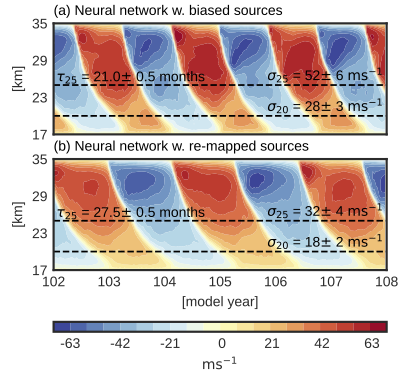
<br /> <img src="/images/2024-08.png" /></p>

<p>An objective index, independent of other periodic modes, allows us to rigorously assess the interactions of the the QBO with the annual cycle.  Claire found that the descent rate of the QBO is substantially perturbed by a mixture of annual and semi-annual cycles, with variations on the order of the mean descent rate.  Using a simple 1-D model, we show that variations in tropical upwelling can explain a good fraction of these variations.</p>]]></content><author><name>Ed Gerber</name><email>epg2@nyu.edu</email></author><category term="submitted" /><summary type="html"><![CDATA[Claire Valva submitted a paper drawing on techniques from dynamical systems analysis to better define and understand the Quasi-Biennial Oscillation. Koopman methods are built for identifying nearly periodic behavior in chaotic systems. We applied it to zonal winds in the tropical stratosphere to objectively identify the Quasi-Biennial Oscillation.]]></summary></entry><entry><title type="html">Stressed out jet streams!</title><link href="https://edwinpgerber.github.io/posts/2024/06/25/" rel="alternate" type="text/html" title="Stressed out jet streams!" /><published>2024-06-25T00:00:00-04:00</published><updated>2024-06-25T00:00:00-04:00</updated><id>https://edwinpgerber.github.io/posts/2024/06/blog-post-1</id><content type="html" xml:base="https://edwinpgerber.github.io/posts/2024/06/25/"><![CDATA[<p>Xingjian (Ken) Yan, a precocious undergraduate (now bound for a PhD at MIT) working with <a href="https://www.leiw.org/">Lei Wang</a> and I just submitted a paper exploring <a href="https://edwinpgerber.github.io/files/yan_etal-GRL-submitted.pdf">the utility of the traffic jam theory of blocking onset for perdiction</a> to <a href="https://agupubs.onlinelibrary.wiley.com/journal/19448007">Geophysical Research Letters</a>.  Ken defined and explored “flux exceedance events”, meteorological situations where the jet stream gets overloaded with storm activity.  <a href="https://www.science.org/doi/10.1126/science.aat0721">Nakamura and Huang</a> suggested that this overloaded jet situation creates a pile up storm activity – a traffic jam – leading to blocking events.  Ken found that the climatological structure of exceedance events is remarkably similar to that of blocks, but that they appear to be distinct phenomenon: an overloaded jet stream is unfortunately not a reliable harbinger of an atmospheric block.<br />
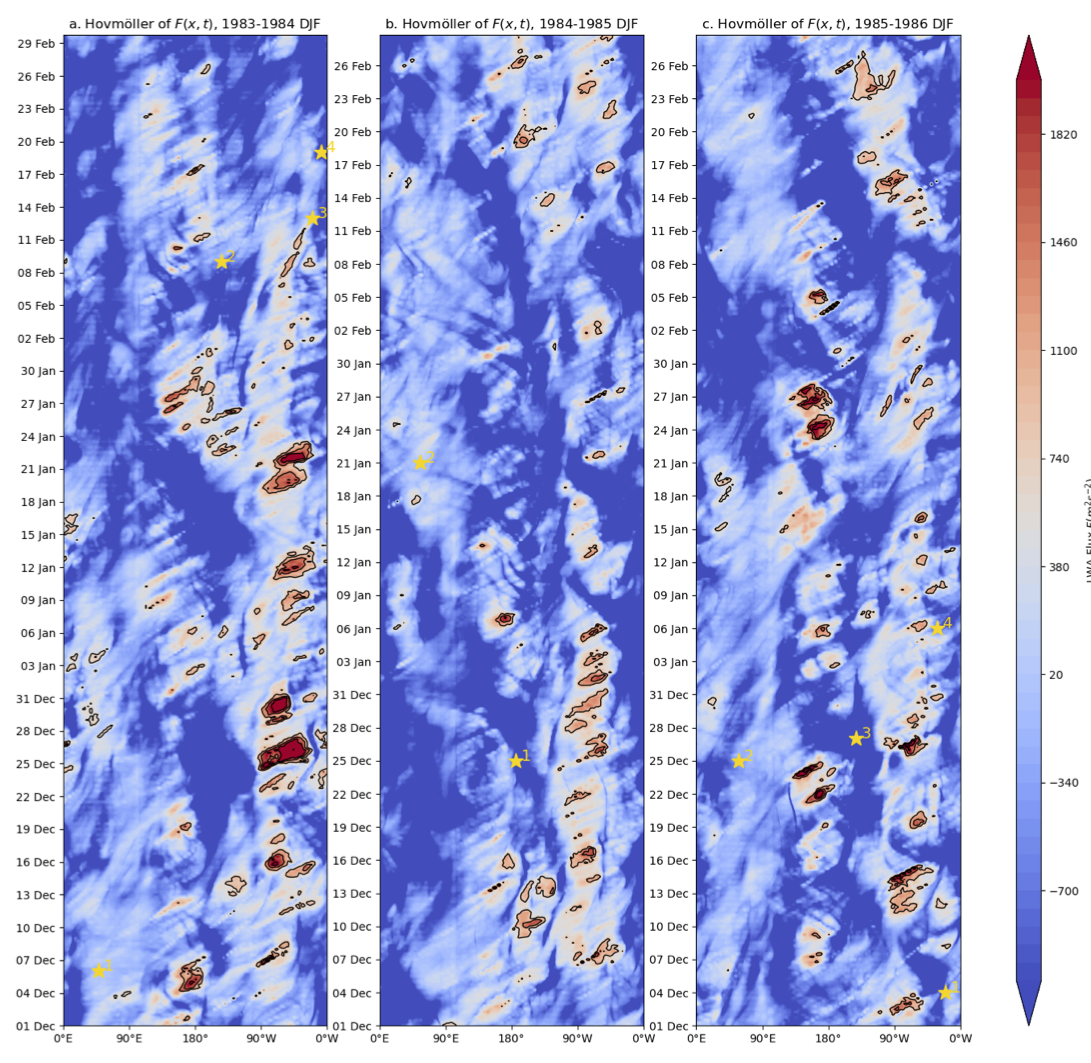
<br /> <img src="/images/2024-06.png" /></p>

<p>As we put it in the plain language summary, an atmospheric block is a large, high pressure weather pattern that blocks the jet stream, affecting many regions in the midlatitudes including North America and Europe.  Blocks are notable for their persistence, driving extreme weather conditions for up to a week or longer.  Despite their significant societal impact, we don’t fully understand the mechanism(s) that generate blocks. A traffic jam theory was proposed, which suggested that the onset of a block is caused by having too much “storm activity flux”, which leads to a pile up of storm activity, just as a traffic jam is precipitated by conditions where the vehicular flux exceeding the road capacity, blocking traffic. We find that this analogy is useful for understanding the preferred locations of atmospheric blocks in the time mean sense, but is not predictive in terms of individual blocking events. We further propose to incorporate additional regional constraints on flux capacity, analogous to “traffic bottlenecks”, to improve our understanding of preferred blocking locations.</p>

<p>Graduate students <a href="https://www.linkedin.com/in/valentina-castaneda-amaya-51a1ba224">Valentina Castaneda Amaya</a> and <a href="https://hk.linkedin.com/in/kaying-ho">Ka Ying Ho</a> contributed to the study as well!</p>]]></content><author><name>Ed Gerber</name><email>epg2@nyu.edu</email></author><category term="submitted" /><summary type="html"><![CDATA[Xingjian (Ken) Yan, a precocious undergraduate (now bound for a PhD at MIT) working with Lei Wang and I just submitted a paper exploring the utility of the traffic jam theory of blocking onset for perdiction to Geophysical Research Letters. Ken defined and explored “flux exceedance events”, meteorological situations where the jet stream gets overloaded with storm activity. Nakamura and Huang suggested that this overloaded jet situation creates a pile up storm activity – a traffic jam – leading to blocking events. Ken found that the climatological structure of exceedance events is remarkably similar to that of blocks, but that they appear to be distinct phenomenon: an overloaded jet stream is unfortunately not a reliable harbinger of an atmospheric block.]]></summary></entry></feed>