Gravity wave momentum transport on a budget
Published:
David Connelly just submitted a paper on Fast, accurate parameterization of atmospheric gravity waves, accounting for transient dynamics to the Journal of Advances in Modeling the Earth System.
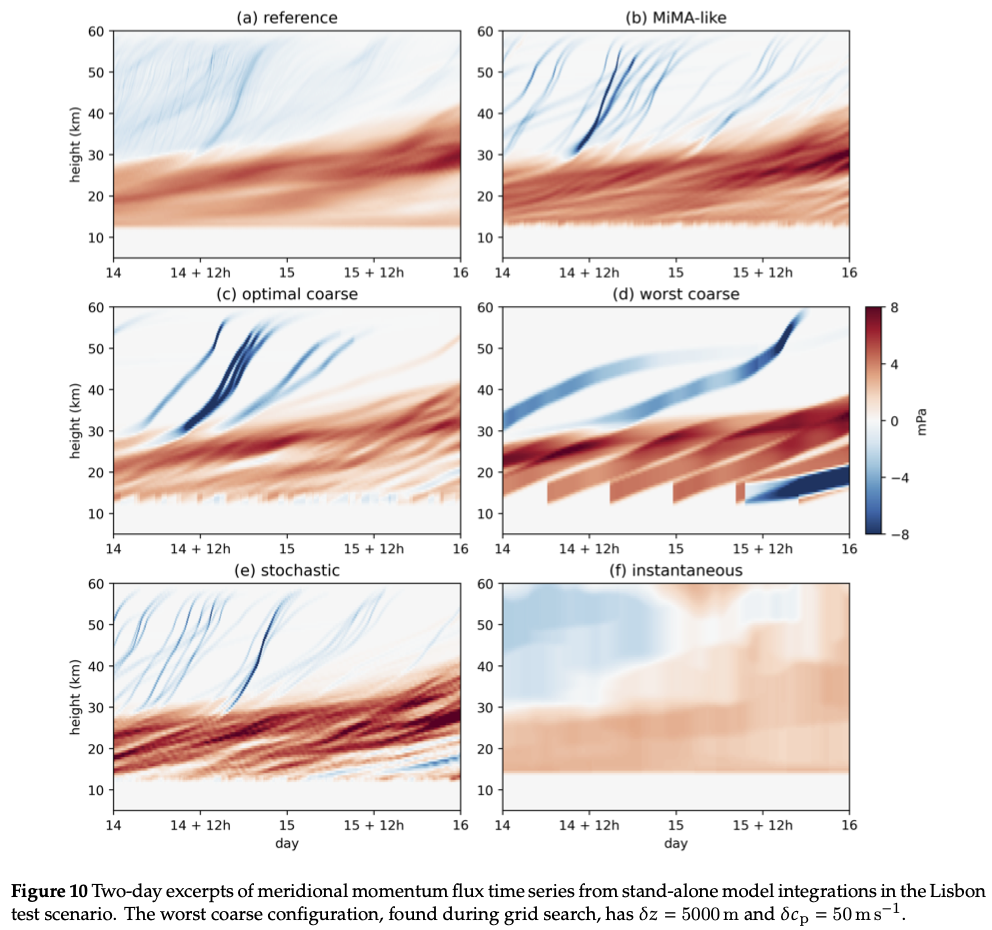
Gravity waves are oscillations in the atmosphere driven by buoyancy and the pull of Earth’s gravity. Common sources include wind blowing over mountains and disturbances associated with convective storms. But while they are typically generated at the surface or in the lower atmosphere, gravity waves can propagate long vertical distances into the stratosphere and affect the velocity and direction of the winds there. Atmospheric models usually represent this propagation as occurring instantaneously, but in reality it takes hours or days, and this transience can significantly alter where and by how much gravity waves accelerate the wind. Transience has historically been too computationally expensive to include in numerical simulation of the atmosphere, but in this paper we find efficient configurations of a model of transient propagation. It proves important to balance the length and time scales of the modeled waves against the available computational power. Using a simplified model, we systematically identify the optimal configuration parameters under significant computational constraints. We then verify that this low-cost configuration performs well when included in a full atmospheric model.