Why is the storm track stronger in the austral hemisphere than the boreal?
Published:
Chaim Garfinkel just submitted a paper on Building blocks of localized storm tracks: revisiting asymmetries between the NH and SH in storm track strength to Weather and Climate Dynamics.
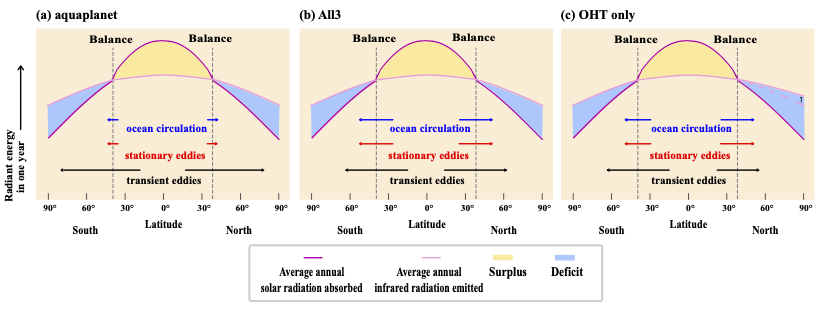
The storm track in the austral (or southern) hemisphere is stronger than that of the boreal (northern) hemisphere. We show how differences in the reflectivity (or albedo) of our planet, continents, and ocean heat transport from the southern hemisphere to the northern hemisphere zonally localize the storm tracks and strengthen storms in the south relative to the north.
More technically, using a intermediate-complexity atmospheric model, we investigate the forcing of localized storm tracks by land–sea contrast, horizontal gradients in ocean heat uptake, planetary albedo, and topography. The additivity of the response to these “building blocks” is investigated. Building on previous work focusing on stationary waves, the storm track patterns and strength are not simply the linear additive sum of the response to each surface inhomogeneity. As observed on Earth, the SH storm tracks are stronger than those in the NH, and also stronger over ocean basins than over continents. In this model, the most important building block for this asymmetry is land-sea contrast, however, there is substantial non-additivity both in the regional structure and also the hemispheric asymmetry.
An energy budget perspective offers some insight on the causes of the non-additivity, and highlights how the net impact of each building block on outgoing longwave radiation is dependent on the existence of the other two. Relatively small changes in oceanic heat transport from the Southern Ocean to the North Atlantic have a pronounced impact on the individual terms making up the energy budget, however there is substantial cancellation between these terms leading to a small impact on the NH vs. SH asymmetry in storm track strength. The detailed structure of albedo has a weak impact on the NH vs. SH asymmetry due to substantial cancellation between the changes in individual terms making up the energy budget, even though the albedo profile has a large impact on the overall transient eddy activity in each hemisphere.